EVELYSS / Guides / Accessories & Jewelry
Accessories & Jewelry · Ms. EvelyssHow to Untangle a Necklace Chain (Without Snapping Fine Links)
Undo the clasp, lay the necklace on a flat, hard surface and rub in a tiny drop of baby oil or a pinch of talc. Use two pins to open the knot from its centre, easing the loops apart without pulling the ends. Wash off the residue with mild soap, then dry thoroughly.
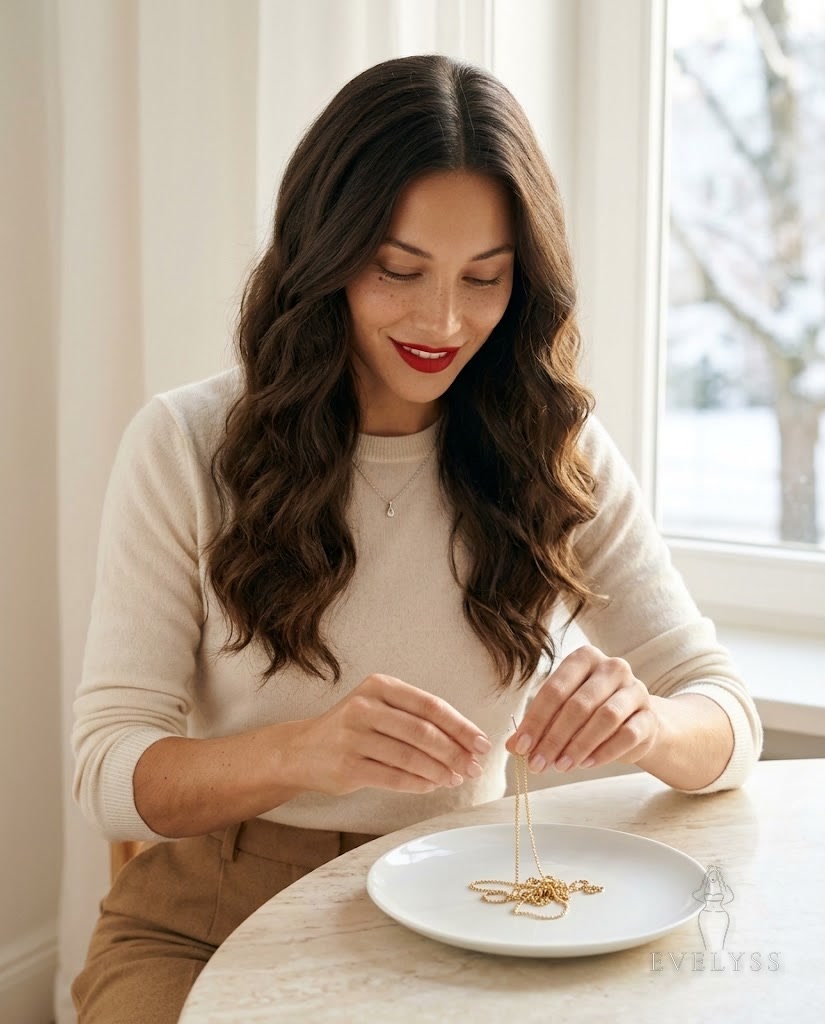
“The knot isn't the enemy; impatience is. Every tug makes it smaller and tighter. Give it light, a pin and the same calm you'd give a splinter, and even that hopeless little ball usually gives up.”Her take
What do you need to untangle a necklace?
Choose a flat, pale surface in good light: a white plate or a sheet of paper makes fine links easier to see. You'll need two straight pins or fine sewing needles, baby oil or talcum powder, a cotton bud, and tweezers if you've got them. Grip gently with tweezers, because squeezing too hard can snap a fine link. Reading glasses or a magnifier can help with delicate chains.
Check what the necklace is made of before reaching for oil. Plain metal chains are straightforward. Pearls, opals, turquoise and other porous stones need more care, so keep oil and powder well away from them.
How to untangle a necklace, step by step
Take your time here. Allow about 10 minutes for a fine chain, because rushing is what breaks links.
- Undo the clasp and spread the chain out so there is as much slack as possible around the knot.
- Put a tiny drop of baby oil on a cotton bud and dab the knot, or rub in a pinch of talc. This reduces friction so the links can slide.
- Press a pin into the middle of the knot and move it gently in small circles to open up the loops.
- Add a second pin, then ease the two pins away from each other. Pull only the loops you've loosened, never the chain's ends.
- As the knot opens, thread the shorter end or clasp back through the loops it passed through.
- If it tightens, stop and add a little more lubricant rather than increasing the pull.
- When the chain is free, wash a plain metal chain in lukewarm water with a tiny drop of washing-up liquid, rinse, and pat dry with a soft cloth. If it has a stone pendant, keep that out of the water and wipe it with a dry cloth.
Oil or talc: which works better?
Use oil for most metal chains with a tightly locked knot, because it lets the links glide. Use talc for very fine chains that you don't want to wash too much, or where a little grip helps you see and hold the loops. You don't need both.
Use the smallest amount that works. Too much oil makes the chain slippery and hard to handle with pins, and it attracts dirt until it's cleaned off. Always wash away the residue, particularly on plated jewellery.
How do you untangle several necklaces knotted together?
Work from the outside in. Undo every clasp and start with the necklace that looks least involved, feeding its clasp end back through the tangle. Avoid pulling two chains apart at once, since that tightens the knots between them.
Once one chain is free, lay it to the side and repeat the process. It's usually faster to free the clasps first, then pick out the middle, than to attack the biggest knot immediately.
When should you stop and take it to a jeweller?
Stop if the chain is antique, you can see a kink or stretched link, the knot is on a pendant fitting, or you've worked gently for 20 minutes without any progress. Snake chains and herringbone chains are also a special case. They don't really knot, and a sharp kink may be permanent.
A jeweller has fine tools, strong magnification and the skill to repair a link if needed. It's also the safer choice for pearls and anything with sentimental value.
How to stop necklaces tangling again
Hang chains separately on hooks or store them in a compartment each. For a suitcase or handbag, thread one end through a drinking straw and fasten the clasp around it, or lay each chain flat in a soft cloth roll.
Fasten the clasp before putting a chain away, and avoid the small jewellery dish on the dressing table: that's where knots are made. If you wear several necklaces at once, a layering clasp or different chain weights will reduce tangling while you wear them.
Questions people ask
Can I untangle a necklace without oil?
Yes. Talcum powder works well on fine chains, and some loose knots will open with pins alone. Oil is most useful when a metal knot is locked tight.
Is baby oil safe for gold chains?
A tiny amount is generally fine on plain metal chains. Wash it off afterwards with lukewarm water and mild soap, and avoid it on pearls and porous stones.
How do I untangle a very fine chain?
Use talc and two fine needles on a pale surface in strong light. Move only one loop at a time, and don't pull the ends.
Should I put a knotted necklace in the washing machine?
No. Spinning can tighten knots, snap fine links and damage plating. Work by hand instead, or ask a jeweller.
Why do fine chains tangle so easily?
They're light and flexible, so links can slide through each other as the chain moves. Hanging or storing each chain separately prevents most knots.
The takeaway
Clasp undone, a tiny bit of lubricant, two pins from the centre, no pulling, and wash it clean when you're done.
Read next
New looks, every day
Her shorts, the Sunday code word for her promo codes, and answers to your questions, on every platform as @msevelyss.
Follow her everywhere → Ask her live →