EVELYSS / Guides / Accessories & Jewelry
Accessories & Jewelry · Ms. EvelyssHow to Read Hallmarks on Gold and Silver Jewellery (UK Marks Explained)
A full UK hallmark has three compulsory marks: the sponsor's mark (the maker's or importer's initials in a shaped outline), the fineness number, such as 375 for 9ct, 750 for 18ct or 925 for sterling silver, and the assay office symbol, such as London's leopard's head. A date letter is optional.
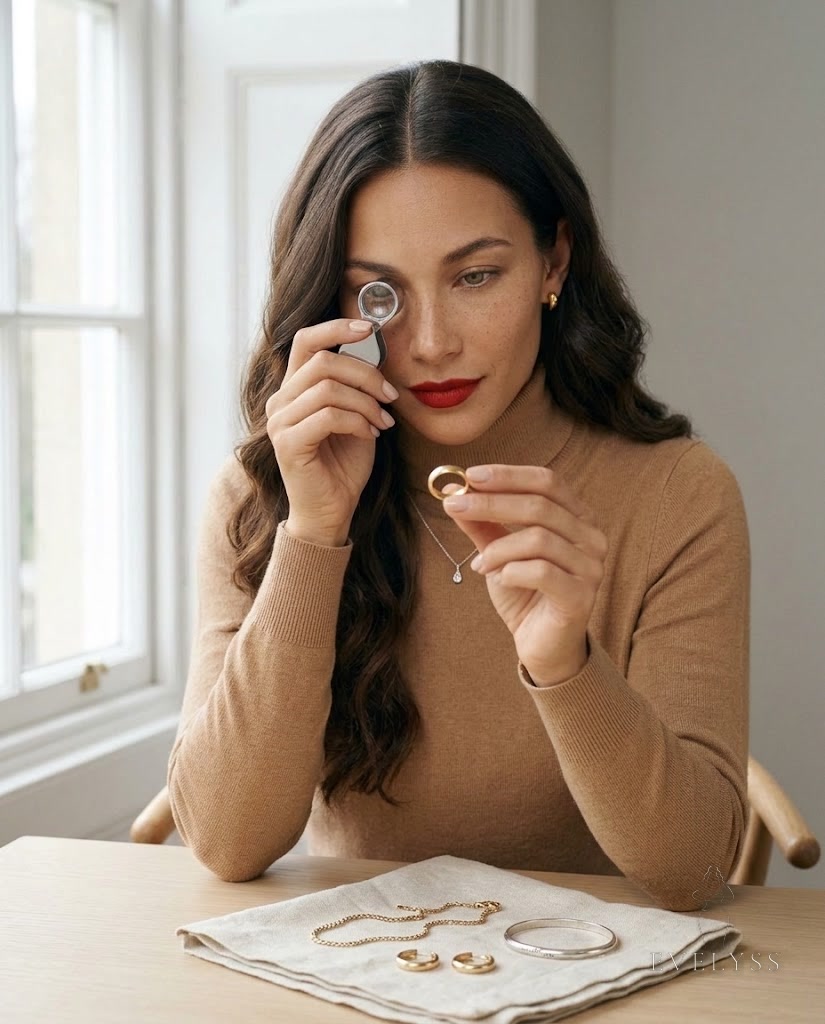
“A hallmark is the most honest thing on a piece of jewellery: a tiny certificate stamped into the metal. Learning to read it takes ten minutes and a magnifier, and it changes how you shop at every vintage fair and jewellery counter.”Her take
What a UK hallmark looks like
UK hallmarks are applied by one of four independent assay offices after the metal has been tested. A complete modern hallmark has three compulsory marks, usually in a row, each often only 1-2mm tall.
You will find it inside the band of a ring, on or near the clasp of a necklace or bracelet, on the post or back of an earring, on a tag near the clasp, or on the back of a pendant.
- Sponsor's mark: the initials of the maker, retailer or importer, inside a shaped outline. Each sponsor's mark is registered to one sponsor.
- Fineness mark: a number showing the precious metal content in parts per thousand, inside a shape that indicates the metal.
- Assay office mark: a symbol showing which office tested and marked it.
The fineness numbers, decoded
The number tells you how many parts per thousand are pure precious metal. The rest is other metals added for strength and colour. The shape around the number also tells you the metal.
- Gold: 375 is 9 carat, 585 is 14 carat, 750 is 18 carat, 916 is 22 carat, and 990 or 999 are 24 carat.
- Silver: 800, 925 (sterling), 958 (Britannia) and 999 (fine silver).
- Platinum: 850, 900, 950 and 999.
- Palladium: 500, 950 and 999.
The four assay office marks
Each UK assay office has its own symbol. Spotting it tells you the piece was tested and marked by a UK assay office.
Older Sheffield silver, from before 1975, carries a crown instead of the rose, which is one reason vintage marks can look unfamiliar.
- London: a leopard's head.
- Birmingham: an anchor.
- Sheffield: a rose.
- Edinburgh: a castle.
Optional marks: symbols, date letters and commemorative marks
Many pieces carry extra marks alongside the compulsory three. Traditional fineness symbols include a crown for gold, a walking lion (lion passant) for sterling silver from the English offices, a standing lion (lion rampant) from Edinburgh, a seated Britannia figure for Britannia silver, an orb topped with a cross for platinum and the head of Pallas Athene for palladium.
A date letter, a single letter in a shaped shield, shows the year of marking. Since 1975 all four offices have used the same letter for each year, changing on 1 January, so one date-letter chart works for any modern UK piece. Since 1999 the date letter has been optional, though many pieces still carry one. Occasional commemorative marks celebrate royal and national events. You may also see a fineness number inside a set of balance scales: the Common Control Mark, an international convention hallmark that the UK recognises.
Stamps that are not UK hallmarks
A number stamped on its own, such as 925, 9K, 18K or 750 without a sponsor's mark and an assay office mark, is a claim by whoever stamped it, not an independent hallmark. It may well be accurate, but it hasn't been verified in the way a full hallmark has.
Some stamps tell you a piece is plated or filled rather than solid: GP (gold plated), HGE or HGP (heavy gold electroplate), RGP (rolled gold plate) and GF (gold filled). These pieces have a thin layer of gold over another metal and cannot be hallmarked as gold.
How to read a hallmark at home
Use a jeweller's loupe or a magnifier of around 10x, and work by a bright window or a desk lamp angled from the side so the light catches the edges of the marks. A phone camera on its macro setting can also capture a readable photo.
Clean the area first with a soft brush and warm soapy water; old marks are often filled with dirt. On rings, tilt the band so you look straight at the inside surface. Read left to right: sponsor's mark, then any traditional symbol, the fineness number, the assay office mark and the date letter.
What if there is no hallmark?
No hallmark doesn't automatically mean a piece is fake. Very light items are exempt: under 1g for gold and palladium, under 0.5g for platinum and under 7.78g for silver, so delicate studs, fine chains and small charms often carry no mark. Very old pieces may also have worn marks.
If you want certainty about an unmarked piece, an independent jeweller or one of the assay offices can test the metal. Ask whether the test is non-destructive before you hand over anything precious.
Questions people ask
Is 9 carat gold real gold?
Yes. 9 carat, marked 375, is 37.5% pure gold mixed with other metals. It is harder-wearing than higher carats and a very popular standard for UK jewellery.
What does 585 mean on gold?
It means 585 parts per thousand pure gold, which is 14 carat.
Is 925 a hallmark?
On its own, no. A 925 stamp is a claim that the piece is sterling silver. A full UK hallmark also includes a sponsor's mark and an assay office mark.
Do all gold rings have hallmarks?
Most solid gold rings sold in the UK do. Very light rings under 1g may be exempt, and older or resized rings can have worn or partly removed marks.
What is the hallmark that looks like weighing scales?
That is the Common Control Mark, an international convention hallmark recognised in the UK. The number inside the scales is the fineness.
The takeaway
Look for three marks in a row: the sponsor's initials, a fineness number such as 375, 750 or 925, and an assay office symbol. A number on its own is a claim, not a hallmark.
Read next
New looks, every day
Her shorts, the Sunday code word for her promo codes, and answers to your questions, on every platform as @msevelyss.
Follow her everywhere → Ask her live →