EVELYSS / Guides / Fashion Sense
Fashion Sense · Ms. EvelyssHow to Layer for Winter Without Looking Bulky
Put the thinnest, warmest layers closest to your body and get thicker as you move out, with only one bulky layer in the whole outfit. Fine merino or silk under a fine-gauge knit, then a coat sized to fit over your thickest sweater, keeps you warm without adding width. Tonal colors make layers look slimmer.
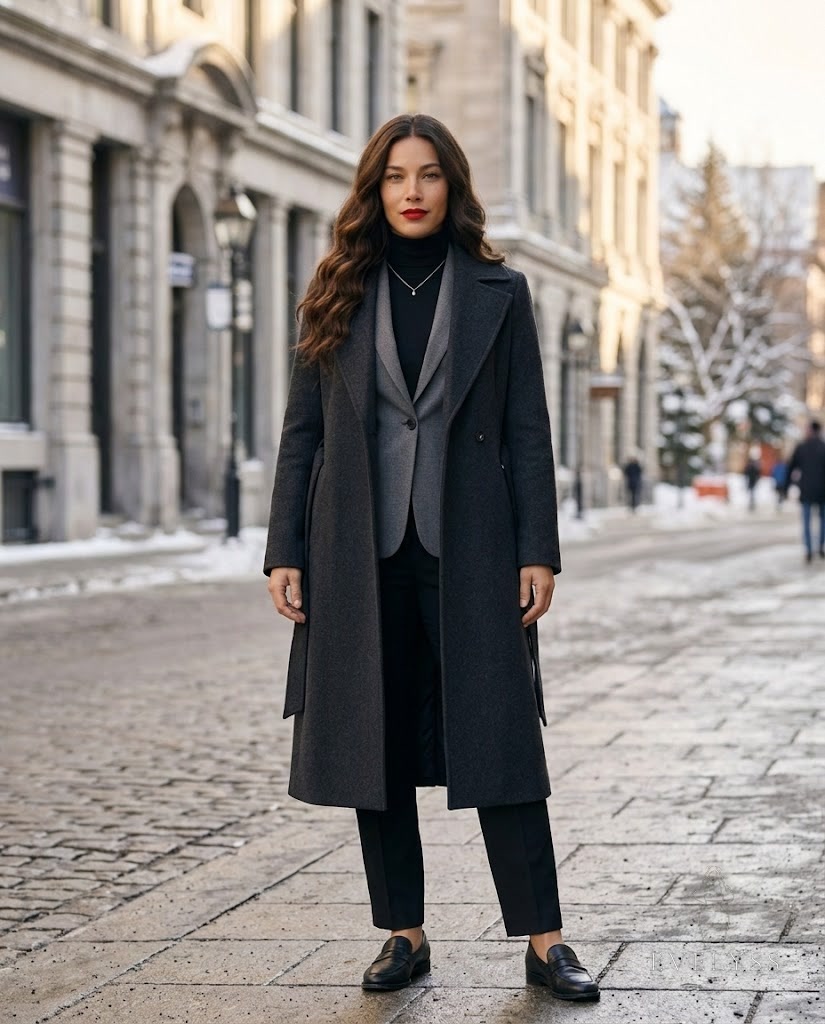
“Bulk isn't caused by layers. It's caused by the wrong layers in the wrong order: a cotton tee bunched under a chunky sweater under a coat that's one size too small. Thin and warm underneath, one texture moment on top, and a coat cut for what's under it. That's the whole secret.”Her take
What is the trick to layering without bulk?
Work from thin to thick. The layer against your skin should be the thinnest and closest fitting, the middle a little heavier, and the outer layer the thickest. When the order is reversed, or two thick layers meet, they push against each other and add inches everywhere.
Allow yourself one bulky piece per outfit. If it's a chunky cable sweater, the coat over it should be roomy and smooth. If it's a big puffer, everything under it should be fine and fitted.
What goes under a sweater?
A thin, close-fitting layer in a smooth fabric. Fine merino wool and silk are warm for how thin they are, and both slide easily under a knit. A fitted thermal top made to be worn as a base layer works too, as long as it's thin.
A loose cotton t-shirt is the most common mistake. It bunches at the waist and armholes, shows through at the hem and adds little warmth. If you want a collar to show, a fine fitted shirt tucked in works better than a thick button-down, and a thin fitted turtleneck under a crew-neck sweater looks polished.
Which fabrics belong in which layer?
Use this as a quick guide when you get dressed.
- Base layer, closest to the skin: fine merino, silk, thin fitted thermals. Close fitting, smooth, no bulky seams.
- Middle layer: fine-gauge knits, cashmere, thin cardigans, fitted shirts, a lightweight quilted vest. Fitted but not tight.
- Statement layer, use one at most: chunky knits, cable knits, fleece, heavy sweatshirts. Only when the coat over it has room.
- Outer layer: a wool or wool-blend coat, a quilted coat or a puffer. Sized for the layers underneath.
- Avoid in the middle: loose cotton tees, thick turtlenecks under thick sweaters, and two textured knits on top of each other.
How tight should a winter coat be?
Try coats on while wearing your thickest sweater. The shoulder seam should sit at the edge of your shoulder, not halfway down your arm and not pinching above it. You should be able to cross your arms and reach forward without the back pulling tight, and the buttons should close without strain.
The sleeves should cover the cuffs of your sweater with a little to spare, so no knit peeks out at the wrist. A coat that fits over your layers actually looks slimmer than a tight one, because nothing pulls or bulges.
Does belting a coat work?
Yes, when what's underneath is thin. A belt or tie at the waist of a wool coat gives your outfit shape and stops the whole look reading as one big rectangle. Tie it at your natural waist, knot it rather than buckling it neatly, and let the coat fall open slightly below.
Over a chunky sweater, a belt bunches the knit into folds and makes the middle look wider, so leave the coat open instead. And belt soft coats, not stiff ones: a structured coat with a belt pulled tight tends to look strained.
How do you layer your legs without bulk?
Tights are the easiest layer of all. Opaque or fleece-lined tights under trousers add warmth with almost no bulk, and they look neater than socks if the hem lifts when you sit. Thin thermal leggings work under wide-leg or straight trousers, but not under slim ones, where every seam shows.
With skirts and dresses, wear opaque tights with a knee-high or ankle boot, and match the tights to the boot or the hem to keep the line long.
How do color and accessories make layers look slimmer?
Tonal dressing does a lot of the work. When your layers are in shades of one color, such as cream, camel and oatmeal, or charcoal, gray and black, the eye reads one long line instead of stacked blocks. An open coat in a column of one color over a darker inner layer makes the body look narrower.
Put warmth in your accessories instead of your torso. A wool scarf, gloves, a hat and boots keep you warm without adding width, and a good scarf is the easiest place to bring in texture or color.
Questions people ask
How many layers should you wear in winter?
Usually three: a thin base layer, a middle knit or shirt, and a coat. Add a fourth thin layer, such as a vest, only if the coat still fits comfortably over it.
Do puffer coats look bulky?
They can. Choose a puffer with narrow stitched channels or a defined waist, and keep everything under it thin and fitted, with slim or straight trousers below.
What is the warmest thin layer?
Fine merino wool and silk are both warm for how thin they are, and they slide easily under knits. Thin fitted thermal tops work well too.
How do I layer a dress for winter?
Wear a thin fitted top or turtleneck underneath if the dress allows it, opaque tights, knee or ankle boots, and a coat long enough to cover the hem or clearly shorter than it.
Should my sweater show under my coat?
A little at the collar is fine and can look styled. At the hem and cuffs, keep the sweater shorter than the coat so it doesn't peek out.
The takeaway
Thin to thick, one bulky piece at most, a coat sized for what's under it, tonal colors, and warmth in the accessories.
Read next
New looks, every day
Her shorts, the Sunday code word for her promo codes, and answers to your questions, on every platform as @msevelyss.
Ask her yours